Activities

The missions of the Lille Regional Airport Management Company include:
Technical Management / Maintenance

The Operations Department is in charge of three types of missions :
The Operations Department processes information it receives from various partners (airlines, public sector services, ground handling companies, etc.), disseminates it and uses it to activate the Airport's various services.
Information lies at the heart of airport operations. The Operations Department uses flight information from airlines and other airports to provide sufficient resources to handle passengers, such as check-in desks, boarding lounges, runway buses, passenger walkways, etc.
It shares all this information with all the service providers and partners concerned (ground handlers, Border Inspection Posts, public sector services, shops, etc.) through its own internal Airport Information System (AIS) and flight forecasting programmes. Finally, it provides passengers with information through the reception and information staff who man the Information Desk in the Arrivals/Departures Hall on a rotating basis.
The Operations Department provides technical supervision for the proper working of the passenger handling equipment (baggage conveying system, Border Inspection Posts, check-in system, digital signage, public address system, etc.) and organises interventions if necessary.
It also oversees passenger well-being by monitoring the "comfort" facilities (air-conditioning/heating, lighting, escalators, lifts) and service equipment (car park pay machines, vending machines, etc.). It works closely with the maintenance services and is assisted in this by a computerised Centralised Technical Management system (CTM), which reports and signals any mechanical problems with the facilities. Finally, the Operations Department monitors safety at the air terminal, classified as a building open to the public (BOP).
When there is an alarm, the operations department personnel carry out an 'emergency confirmation' process, checking the validity of the alarm in less than 5 minutes.
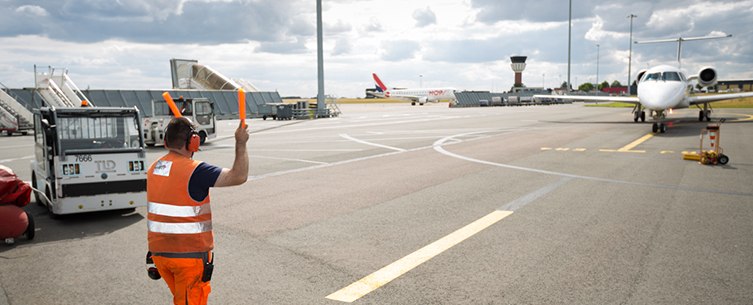
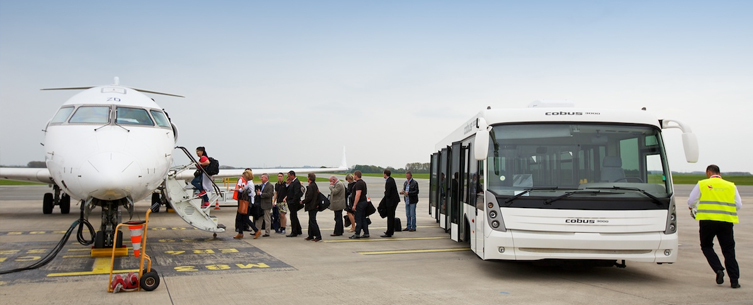
For the airlines, the Operations Department must guarantee the rapid processing of passengers in the terminal in order to avoid delays in the aircraft flight schedules. To do this, it boards and disembarks passengers using passenger walkways or runway buses at the scheduled time and within the allowed time limits.
It also assists Passengers with Reduced Mobility (PMR). The Airport provides PMR assistance on behalf of the airline. Finally, it assists general aviation airlines, namely business aviation, private VIP jets and flying club planes, and even military flights or emergency medical flights (organ transportation, evacuations, etc.).
To provide airline ground services, the Operations Department works closely with the airline airport ground service provider Aviapartner

The Commercial Department's main mission is to develop Lille Airport's activities, whether aviation-related or not.
As regards aviation activities, the department works hard to persuade airlines to launch new services from Lille Airport or increase their existing schedules departing from Lille Airport. It is therefore in regular contact with airline managers, to whom it promotes both Lille Airport's advantages and the traffic potential of its trade area, identified by market studies, regular analysis of traffic statistics and continuous monitoring of the competition. The department approaches regional, national and international Tour Operators in the same way.
In relation to non-aviation activities, it identifies potential in terms of new businesses or services which could be offered by Lille Airport.
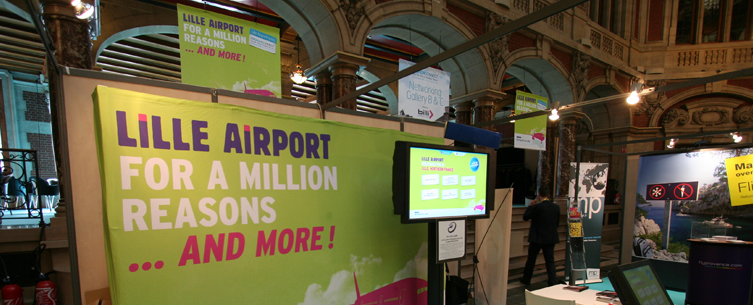
The Commercial Department works to promote travel services departing from Lille Airport. Through brochures, advertisements, participation in various regional Travel and Tourism Fairs and by direct approaches to businesses, travel agencies, etc., it contributes to increasing public awareness of these service offers.
The Commercial Department also carries out potentiality studies and satisfaction surveys to identify areas for improvement and progression for the services and shops at Lille Airport.

The Technical Department is involved in three main areas :
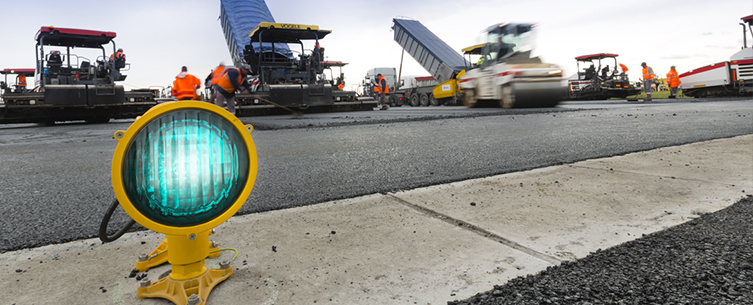
The New Projects department has an engineering role at Lille Airport. It defines the needs, resources and methods required to carry out a project, in most cases by issuing invitations to tender. It also supervises work undertaken by other companies, up to the acceptance of the work. The New Projects department has a wide field of competence, ranging from general roads and utilities to ground lighting and planning office spaces or the construction of buildings.
The Maintenance Department is responsible for checking all the equipment and facilities managed by Lille Airport and keeping them in good working order. So its operational sphere is particularly broad, as it is responsible for the maintenance of the 'critical' equipment, that is, the equipment which has a direct impact on flights and passenger handling (baggage conveyance, walkways etc.), and also for buildings and equipment maintenance (car parks, terminal, hangars, fencing, roads and utilities, telephone networks, electrics, sanitation etc.).
The Maintenance Department also maintains the runway lighting. This is a vital component of Lille Airport's activity because the runways are used 24 hours a day and are classified 'Category 3', which means it has to accommodate landings in all types of weather. Finally, the Maintenance Department is responsible for removing snow and de-icing the runways to make Lille Airport's facilities accessible 24 hours a day.

Safety at Lille Airport is a generic term covering a wide variety of tasks. These tasks are focused around three main areas :
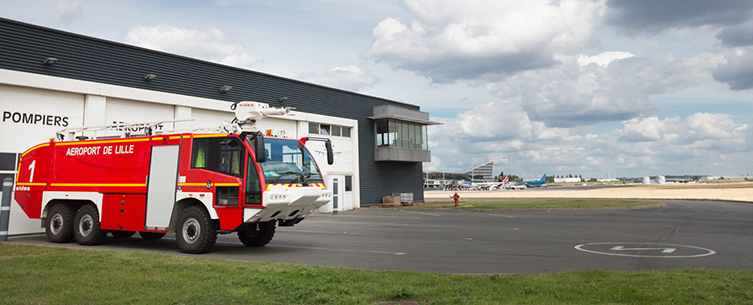
At Lille Airport, this task is supervised by a Safety Manager, who heads a team of fire-fighters and several multidisciplinary personnel. The Rescue and Fire-Fighting Service (RFFS).This mission has been delegated by the State to Lille Airport services. The Rescue and Fire-fighting Service's role is to :
The RFFS is on standby 24 hours a day, with a response time of less than three minutes.
In Lille, there are 28 assigned agents housed in a building which was specially constructed in 2004, in close proximity to the runways and facilities.
Prevention of bird strike hazards involves preventing the risk of birds being sucked into the jet engines. A team regularly inspects the runways and if necessary scares away the birds by means of sound recordings and/or explosive cartridges.
As the safety rules for buildings which are open to the public have been defined by the State, Lille Airport ensures compliance with these rules (restrictions regarding fire resistance in materials and building components, the proper working of safety equipment – smoke extraction, extinguishers, alarms, fire detectors etc.). To fulfil these tasks, the Safety Manager relies on a multidisciplinary team whose job is to check the equipment using a Centralised Technical Management system*. *also see the Operations section
The RFFS and bird strike prevention missions are assigned to the Securitas company and supervised by the Safety Department.

Security concerns the prevention of and protection against malicious acts and illicit behaviour: attacks, hostage-taking, hijacks etc. (not to be confused with Safety which concerns prevention against and aid in the event of various types of accidental incidents such as accidents, fires etc.)
The State delegates responsibility for Security. Since 2000, this mission has been delegated to Lille Airport, which acts on behalf of and under the responsibility of the State. Security at Lille Airport covers two essential missions :
- Hand Baggage inspection at the Border Inspection Posts (BIP)
- Checked Baggage Inspection (CBI)
The airport security service also prevents the risk of intrusion into the restricted area. It also supervises the issue of access and vehicle badges for different areas of the airport. In this regard, it also has the role of training people who drive on the site (employees, service providers, sub-contracting companies etc.)
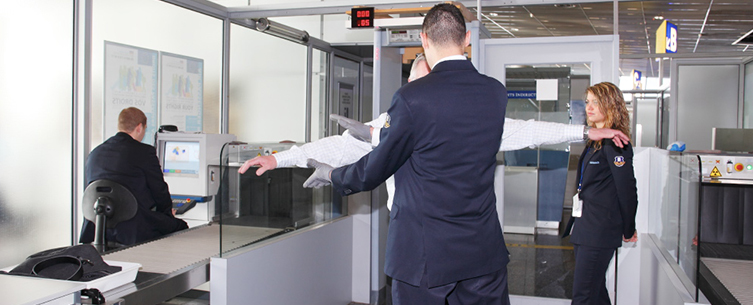
The hand baggage inspection at the Border Inspection Posts includes checking passengers as well as hand baggage (cabin baggage). The role of the hand baggage inspection personnel is to ensure that there are no objects in hand baggage or on the passenger's person which could threaten the safety of passengers or the aircraft. These inspections are carried out before passengers reach the boarding lounge. (See section on Prohibited Objects in the Cabin in the Passenger Guide menu)
Numerous efforts are made, in terms of the allocation of human resources and in the ergonomic design of the posts, to make these controls run more smoothly, with less inconvenience. However, these efforts to reduce waiting times do not reduce the number or rigour of these inspections.
Checked baggage is checked in the same way as passengers and hand baggage. Lille Airport was one of the first airports to implement 100% checked baggage inspection. Therefore, checked baggage is inspected by several machines in succession which have complementary technology and which operate using X-rays. Their aim is to detect explosives.
The passenger and baggage inspection missions are assigned to the Brink’s company and supervised by the Security Department